Ticks and Lyme Disease
Windsor-Essex County (Ontario, Canada) Health Unit
From a pamphlet produced by the
Windsor-Essex County Health Department (Ontario, Canada). Revised 1998.
(Please note that the information may have changed
since this article was written)
Lyme disease is a disease caused by the black legged tick [also
known as the Deer tick]. It can cause you years of trouble if not treated. Ticks carrying Lyme disease are rare in Ontario except on Long Point on the north shore of Lake Erie where the black legged ticks have been established. In Point Pelee, the black legged ticks have been identified. The bacteria causing Lyme disease was found in a tick removed from a dog visiting the park in 1994.
HELPFUL HINTS
-
Wear light-coloured clothing. It makes ticks easier to spot.
-
Don't walk barelegged in tall grass, woods or dunes where ticks may be found.
-
Wear long pants and a long-sleeved shirt. This will delay the time it takes the tick to find an attachment site. Wear closed footwear and socks, never sandals. Tuck your pants into your socks.
-
Use an insect repellent that has "Deet". Apply it to your skin and outer clothing. Avoid your eyes and mouth, as well as cuts and scrapes.
-
Put a tick and flea collar on your pet and check for ticks periodically.
-
Search your body well for ticks. It's important to do this each day. Pay special attention to areas such as groin, scalp and armpits.
-
Use a mirror to check the back of your body or have someone else check it.
-
Stay on groomed paths when possible
LOOKING FOR TICKS AND TICK BITES
Ticks are tiny and cannot fly. They move about the ground slowly. Or they settle on tall vegetation until they can attach themselves to someone passing by. They can work their way through your clothes and bite into your skin. As it feeds on your blood, a tick can swell to the size of a raisin.
Tick bites may or may not hurt or itch. You have to look for them on your body. Do this as soon as you can when you return from the woods or fields. A tick can give you disease if not removed within 24 to 48 hours.
LYME DISEASE
Lyme disease may lead to complications if left untreated.
A red skin rash usually appears within a few days to a month. The rash will be five centimeters or more in size (about two inches), with a clear area in the middle. (doughnut-shaped)
The skin lesion may burn or itch. You may also be very tired and have a fever.
Lyme disease is not deadly. It can be treated with antibiotics. The earlier you receive treatment, the better. If not treated, the following symptoms may appear in time:
If you think you have any of the symptoms, get in touch with your doctor right away.
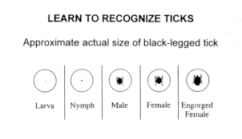
LEARN TO RECOGNIZE TICKS
IF YOU SPOT A TICK
-
Don't squeeze the tick. Squeezing can speed up infection.
-
Don't try to burn it off or put anything on it.
-
Grasp the tick as close to your skin as possible. Pull it straight out with a slight twisting motion, gently but firmly. Use tweezers if possible. Disinfect the bite with rubbing alcohol.
-
Save the tick alive in a jar if you can. Your doctor can have the tick identified by sending it to the Public Health Lab.
|