|
|
Home →
Survival →
Cordage
Dogbane Cordage
|
| Very good cordage can be made from Dogbane.
There are actually 4 plants that are commonly referred to as "dogbane",
and they are very similar:
- Spreading Dogbane (Apocynum androsaemifolium)
- Intermediate Dogbane (Apocynum medium)
- Indian Hemp (Apocynum cannabinum)
- Clasping-leaved Dogbane (Apocynum sibiricium)
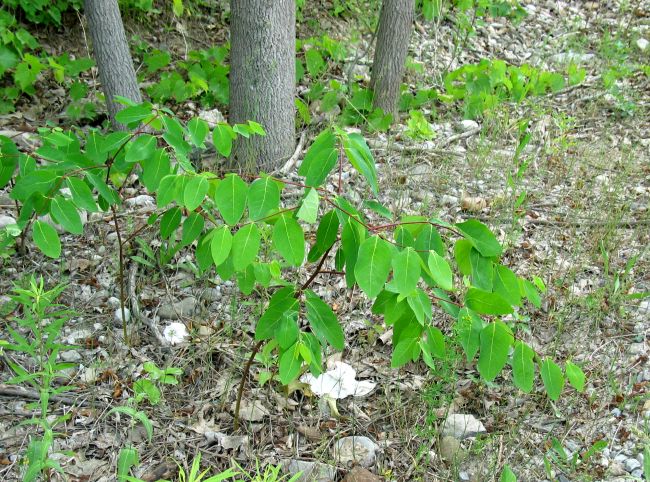
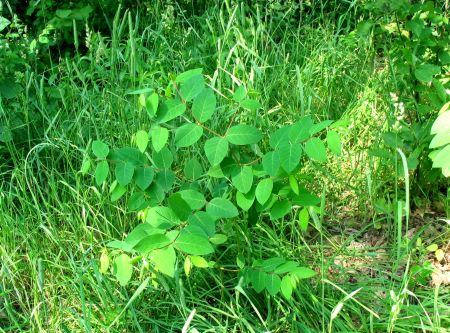
Here is a set of photos of the plant itself, and showing how the raw materials are collected from
dogbane.
The part of the plant that is used to make cordage is
the fibers in the "bark" or "skin" of the stalks. The
time of year to collect the fibers is late fall. Earlier, and the plant
is still alive. The fibers have to dry out so they will detach from the
plant easily. As well, the fibers aren't as strong until the plant dies.
Please note that dogbane is poisonous to ingest (eat).
So when you're working with dogbane, wash your hands before eating.
|
| |
|
|
|
|
 |
Here's a couple more photos of Dogbane so you can
more easily identify it.
|
|
| |
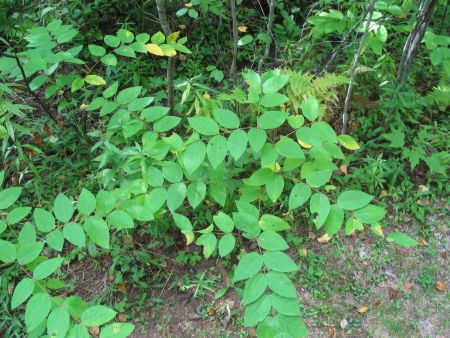 |
There are actually 4 types of Dogbane, but for the purposes of
cordage-making, they're essentially the same. |
|
| |
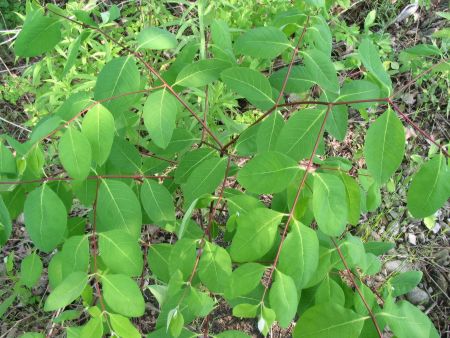 |
Here's a closer view of the plant, showing how the
stems branch. |
|
| |
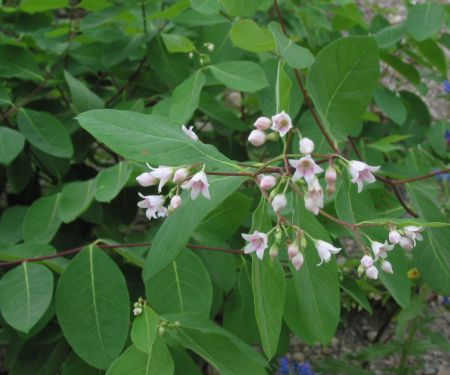 |
Dogbane in flower.
Now is not a good time to collect cordage material from the
plant!
It has to die and dry out a bit first. So late fall would be the
best time.
|
|
| |
|
|
|
|
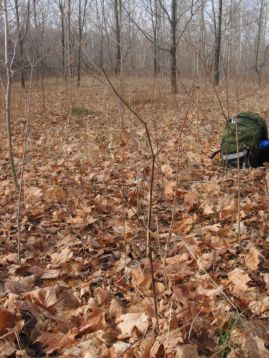 |
Here is a dogbane
plant in late fall (it's the plant in the center of the photo).
Dogbane grows on forest edges and in forest
clearings. It can also be found in fields. Here it is growing
on a forest edge and forest clearing. |
|
| |
|
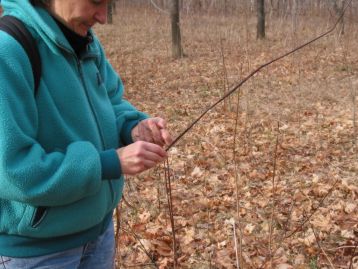
|
This dogbane stalk
is about to give up its fibers:
First break off the stalk at ground level. Then
strip the fibers of the "bark" or "skin" of the
stalk, from the bottom up. |
|
| |
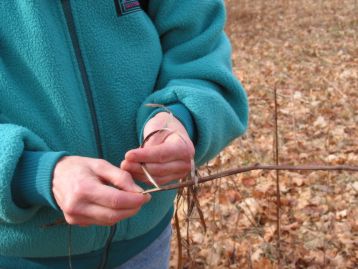 |
Move slowly, and try to
keep the strip as wide as possible as you move up the stem. |
|
|
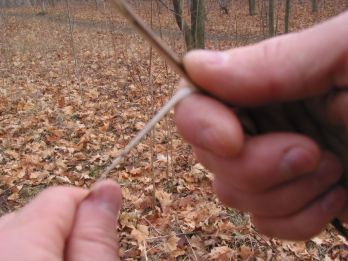 |
Here's an alternative way
that works really well. Hold the stalk in one hand and gently
pull the bark strip away with the other, sliding the "holding
hand" along the stalk as the bark is stripped away. (My
apologies for this photo being out of focus - I hope to get a better
one soon). |
|
| |
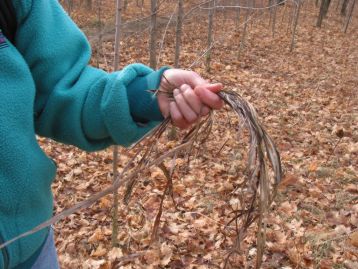 |
The result of a few
minutes work: a bundle of dogbane fibers, ready to be cleaned and
made into cordage. |
|
| |
| After stripping the bark from the plant, you
will need to clean the thin "skin" from the fibers.
|
|
|
|
|


